By the In Da Streets Radio Team
There's an old saying in entertainment:
"If they're talking... they're streaming."
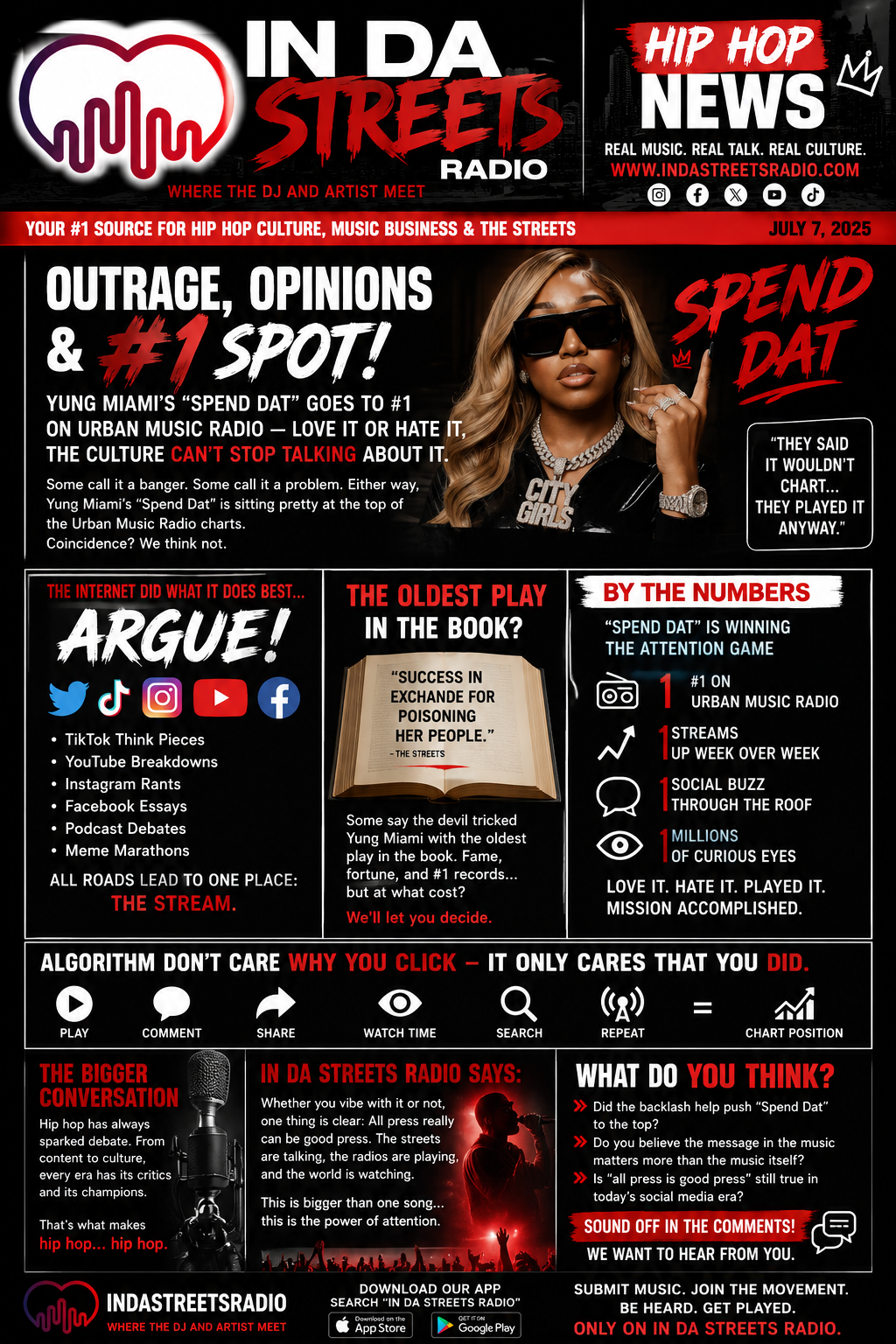
And judging by the internet over the past few days, Yung Miami's "Spend Dat" found itself sitting comfortably in the middle of one of hip hop's oldest marketing campaigns...
Controversy.
Here's the funny part.
Some people absolutely love the record.
Some people absolutely hate the record.
Some people have never heard the record...
...until everyone started arguing about it.
Congratulations.
You accidentally became the marketing department.
The Internet's Favorite Hobby: Outrage
Social media has become the world's largest unpaid street team.
Someone says,
"This song is destroying the culture."
Another replies,
"This is female empowerment."
Then comes the YouTube breakdown.
The TikTok think pieces.
The reaction videos.
The podcasts.
The Facebook dissertations from people who suddenly became professors of Hip Hop Ethics overnight.
Meanwhile...
Someone who had absolutely no intention of listening says,
"Hold on... let me see what everybody's talking about."
Play.
Another stream.
Another chart point.
Another algorithm boost.
Music executives everywhere:
"Keep arguing."
The Oldest Play in the Book?
Of course, whenever a record becomes controversial, another conversation quickly follows.
Some critics argue that artists are rewarded for creating content they believe is harmful to the community.
Others take it a step further, saying it's "the oldest play in the book"—that fame and success can come at the expense of promoting messages they believe negatively influence listeners.
That's a deeply held opinion for many people, and it reflects broader conversations about responsibility in entertainment.
Whether you agree with that perspective or not, one thing is undeniable:
Controversy moves attention.
And attention has become today's currency.
Wait... Didn't Everybody Say They Weren't Listening?
Here's the part that made us laugh.
Thousands of people posted about how terrible the song supposedly was...
...while simultaneously sharing clips of it.
They quoted lyrics.
They stitched videos.
They made memes.
They debated it on live streams.
They reposted interviews.
They gave free promotion that many independent artists would gladly pay thousands of dollars to receive.
If irony were a streaming platform...
that would've gone platinum too.
The Algorithm Doesn't Care Why You Clicked
Here's the cold truth about today's digital world.
Algorithms don't have morals.
They have metrics.
They don't ask:
"Did you approve?"
They ask:
"Did you engage?"
Comments.
Shares.
Watch time.
Searches.
Reaction videos.
Everything feeds the machine.
The internet rarely distinguishes between applause and outrage.
It just counts the clicks.
So... Did the Backlash Help?
Let's just say this:
When everyone is discussing one song...
guess which song people are most likely to hear?
Exactly.
Whether listeners pressed play out of curiosity, criticism, or genuine support, the result is often the same:
More streams.
More visibility.
More conversations.
And sometimes...
more chart success.
The Bigger Conversation
Hip hop has always sparked debate.
From N.W.A. to 2 Live Crew...
from gangsta rap to drill...
from conscious rap to party records...
every generation argues over what represents the culture.
Maybe that's part of what makes hip hop exactly what it is—a mirror reflecting conversations happening far beyond the music itself.
Final Thoughts
Whether you think "Spend Dat" is brilliant, terrible, entertaining, or somewhere in between...
one lesson remains undefeated:
Attention is one of the most valuable commodities in entertainment.
Sometimes applause creates it.
Sometimes criticism creates it.
And sometimes...
the people trying hardest to stop a record become the very reason everyone hears it.
Funny how that works.
What Do You Think?
Did the backlash help push "Spend Dat" to the top through curiosity and conversation, or would the song have become a hit regardless?
Do you believe the saying "all press is good press" still applies in today's social media era, or has the internet changed the rules?
Drop your thoughts in the comments and join the conversation. We want to hear both sides.
Follow In Da Streets Radio for more unfiltered takes on hip hop, music business, and the culture that keeps us talking.











Comments(0)